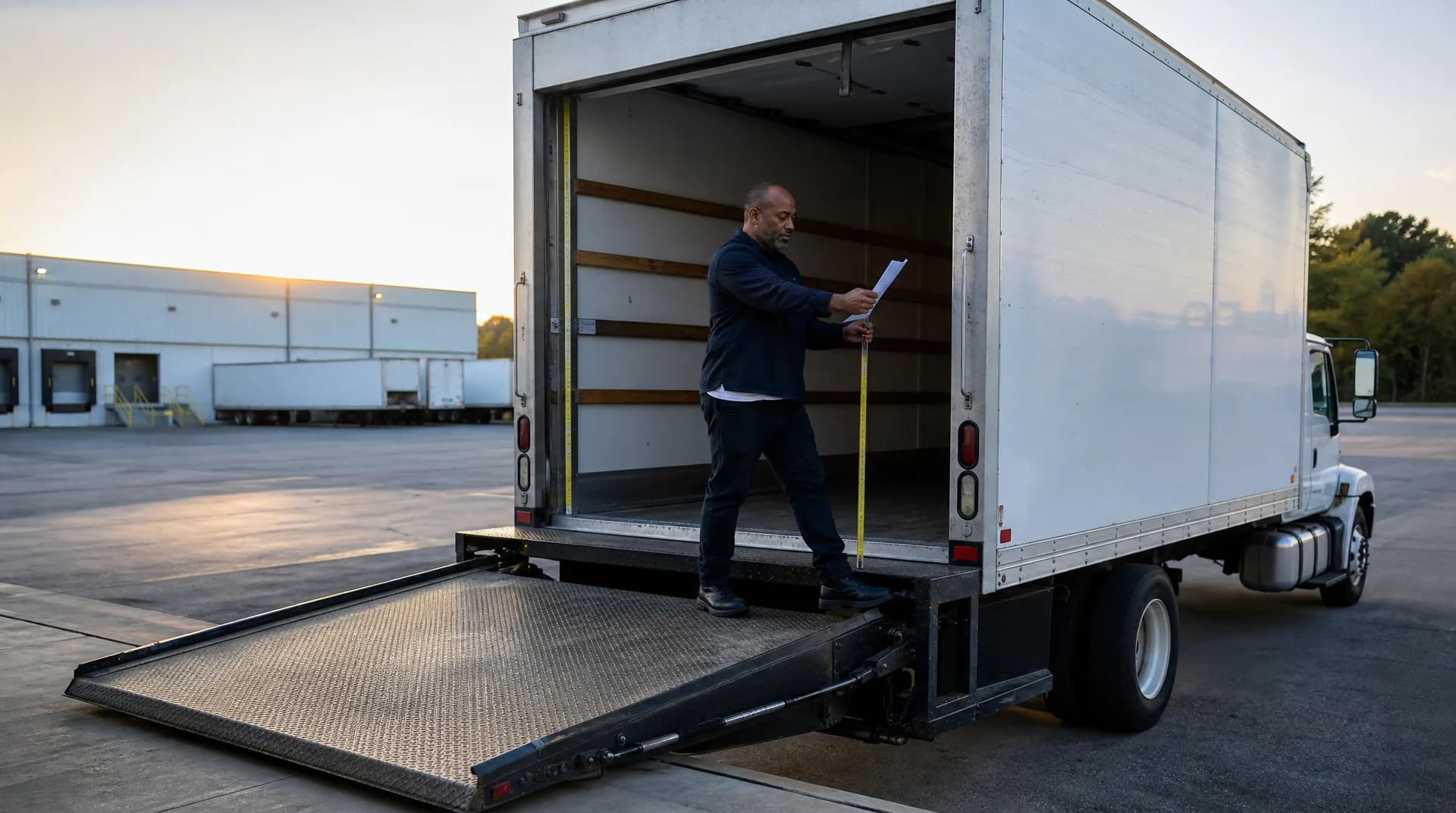
Federal hours of service rules and the ELD requirement apply when you drive a commercial motor vehicle in interstate commerce. For a truck hauling freight, that starts at 10,001 pounds, by rating or actual weight. A cargo van or Sprinter under that line is outside the federal rules. Over it, you log, unless a short-haul exception covers the day.
Under your own MC you are the driver and the motor carrier at the same time. The rules in 49 CFR Part 395 give one set of duties to the driver and another to the carrier, and both land on you. This guide walks through who is covered, which exceptions can take you off the log, when a paper log is still allowed and what you have to keep as the carrier.
Does Part 395 apply to your truck?
Part 395 applies to motor carriers and drivers of commercial motor vehicles (49 CFR 395.1). A truck carrying property is a commercial motor vehicle (CMV) when it is used in interstate commerce and its weight rating or actual weight, alone or with a trailer, is 10,001 pounds or more, whichever is greater. Carrying hazmat in a quantity that requires placards also makes it a CMV at any weight (49 CFR 390.5).
| Your situation | Federal hours of service |
|---|---|
| Van or Sprinter rated under 10,001 pounds, no trailer, loaded within its rating | Does not apply |
| Same van pulling a trailer that puts the combination at 10,001 pounds or more | Applies |
| Sprinter or box truck rated at 10,001 pounds or more, interstate | Applies |
| Any truck carrying placarded hazmat, interstate | Applies |
| Any truck, all work truly intrastate | Federal rule does not apply; your state’s rules do |
The same model name covers configurations on both sides of the line, so go by the label on your own door frame. How to read the four weight numbers, and how a trip inside one state can still count as interstate, is covered in when a Sprinter or box truck driver needs a DOT medical card. The same line decides both questions.
What are the limits once you are covered?
For a property-carrying CMV, the limits in 49 CFR 395.3 are:
- 10 hours off before you start a shift.
- A 14-hour window. You cannot drive after the 14th consecutive hour since coming on duty. Off-duty breaks do not pause it, except under the sleeper berth provisions.
- 11 hours of driving inside that window.
- A 30-minute break after 8 hours of driving. Off duty, sleeper berth or on duty not driving all count.
- 60 hours in 7 days or 70 hours in 8 days. 60/7 if your company does not operate trucks every day of the week, 70/8 if it does.
- 34 hours off restarts the 7 or 8 day period.
On duty is more than driving. Loading, unloading, waiting at a shipper to be dispatched, inspecting the truck and attending it while it is loaded all count against the 14 hours and the 60 or 70 (49 CFR 395.2). These limits apply to each driver on their own, which is why a team keeps a truck moving; see running team in a cargo van.

Own your truck and your MC?
StarBriges works with cargo van, Sprinter, box truck and straight truck owner-operators who run under their own authority. Send us your MC and truck details. We’ll review them within one business day.
Apply to run with StarBriges →Which short-haul exceptions take you off the log?
Two exceptions in 49 CFR 395.1(e) free a driver from keeping a log under 395.8. Neither one frees you from all of the limits, and both require a return to the same work reporting location.
| 150 air-mile driver, 395.1(e)(1) | Non-CDL driver, 395.1(e)(2) | |
|---|---|---|
| Who | Any property-carrying CMV driver | Driver of a property-carrying truck that does not require a CDL |
| Radius | 150 air-miles (172.6 statute miles) from the normal work reporting location | 150 air-miles from the place you report to and are released from |
| Return | Back and released within 14 consecutive hours | Back at the reporting location at the end of each duty tour |
| Daily limit | 10 hours off between each 14 hours on duty | No driving after the 14th hour on duty on 5 days of any 7, after the 16th hour on 2 days of any 7 |
| Log and 30-minute break | Not required | Not required |
| Still applies | 11 hours driving, 60/70 hours | 10 hours off, 11 hours driving, 60/70 hours |
| Time records | Carrier keeps 6 months: start time, total hours, release time | Same |
For general freight without placarded hazmat, a single truck needs a CDL at 26,001 pounds or more by rating or actual weight, whichever is greater (49 CFR 383.5). So a cargo van, a Sprinter or a box truck that stays under 26,001 pounds by both measures can use the non-CDL exception. A driver who uses it cannot also use the 150 air-mile exception, the sleeper berth provisions or the 16-hour short-haul provision.
Both exceptions are written for a driver who comes home to the same place every night. A run that takes you past 150 air-miles, or one that ends somewhere else, does not meet the conditions, and on that day the regular log applies. Even on exempt days, you as the carrier still have to keep the time records.
ELD or paper log?
When you have to log, the default is an electronic logging device (49 CFR 395.8). A paper log on the federal graph grid is still allowed when:
- you need a record of duty status on no more than 8 days in any 30-day period, which fits a driver who works under a short-haul exception and only occasionally runs past it;
- the truck was made before model year 2000, going by the VIN on its registration;
- the truck you drive is itself the shipment being delivered, in a driveaway-towaway operation.
Once you are past 8 logged days in a 30-day window, the ELD requirement applies. An ELD has to be one listed on FMCSA’s registered ELD list (49 CFR 395.22). Check that list before you buy a device, not after.
What do you keep as your own motor carrier?
A company driver hands most of this to the carrier’s safety department. With your own MC, it is yours:
- ELD account. The carrier creates the driver’s ELD account using the driver’s name and valid license number, and keeps it accurate (395.22).
- In-cab packet. An instruction sheet for sending your logs to an officer, an instruction sheet for what to do if the ELD malfunctions, and blank paper grids for at least 8 days (395.22).
- Backup. A backup copy of ELD records for 6 months, on a device separate from the one that holds the original (395.22).
- Retention. Records of duty status and supporting documents for at least 6 months. While on duty, the driver has the last 7 days available for inspection (395.8).
- Malfunctions. The driver gives the carrier written notice within 24 hours, rebuilds the current day and previous 7 days on paper and keeps paper logs until the ELD is fixed. The carrier has 8 days to repair or replace it (49 CFR 395.34). When you are both, write the notice to yourself anyway and keep it with the logs.
Logs sit next to the other paperwork that keeps an MC in good standing, from the biennial update to insurance filings. That side is in keeping your authority active.
What if your van is under 10,001 pounds?
Federal hours of service and the ELD rule do not reach it. Two things can change that on a given day: hooking up a trailer that takes the combination to 10,001 pounds or more, or loading the van past its rating until its actual weight reaches the line. Placarded hazmat does it at any weight. If you work only inside one state, the federal rules do not decide your hours; your state’s rules do.
Frequently asked questions
Do I need an ELD in a cargo van?
Not if the van is rated under 10,001 pounds, its actual loaded weight stays under that too, and you carry no trailer and no placarded hazmat. It is not a CMV, and Part 395 does not apply to it (390.5). Check the label on your own van.
Does a non-CDL box truck need an ELD?
Yes, if it is a CMV in interstate commerce and you have to log on more than 8 days in a 30-day period. If you stay within 150 air-miles and return to your reporting location every day, the non-CDL short-haul exception removes the log, though the time records still have to be kept (395.1).
Can I use paper logs in an older truck?
Yes, if the truck was made before model year 2000 according to the VIN on its registration (395.8). Paper logs still have to follow the federal graph grid and every other hours of service rule.
Does the 30-minute break apply to short-haul drivers?
No. Drivers who qualify for either short-haul exception are not subject to the 30-minute break after 8 hours of driving (395.3).
Does StarBriges work with Sprinter and box truck drivers?
Yes. StarBriges works with cargo van, Sprinter, box truck and straight truck drivers, and currently partners with active carriers who have both their own truck and MC authority. If you are set up, see how to run with StarBriges.