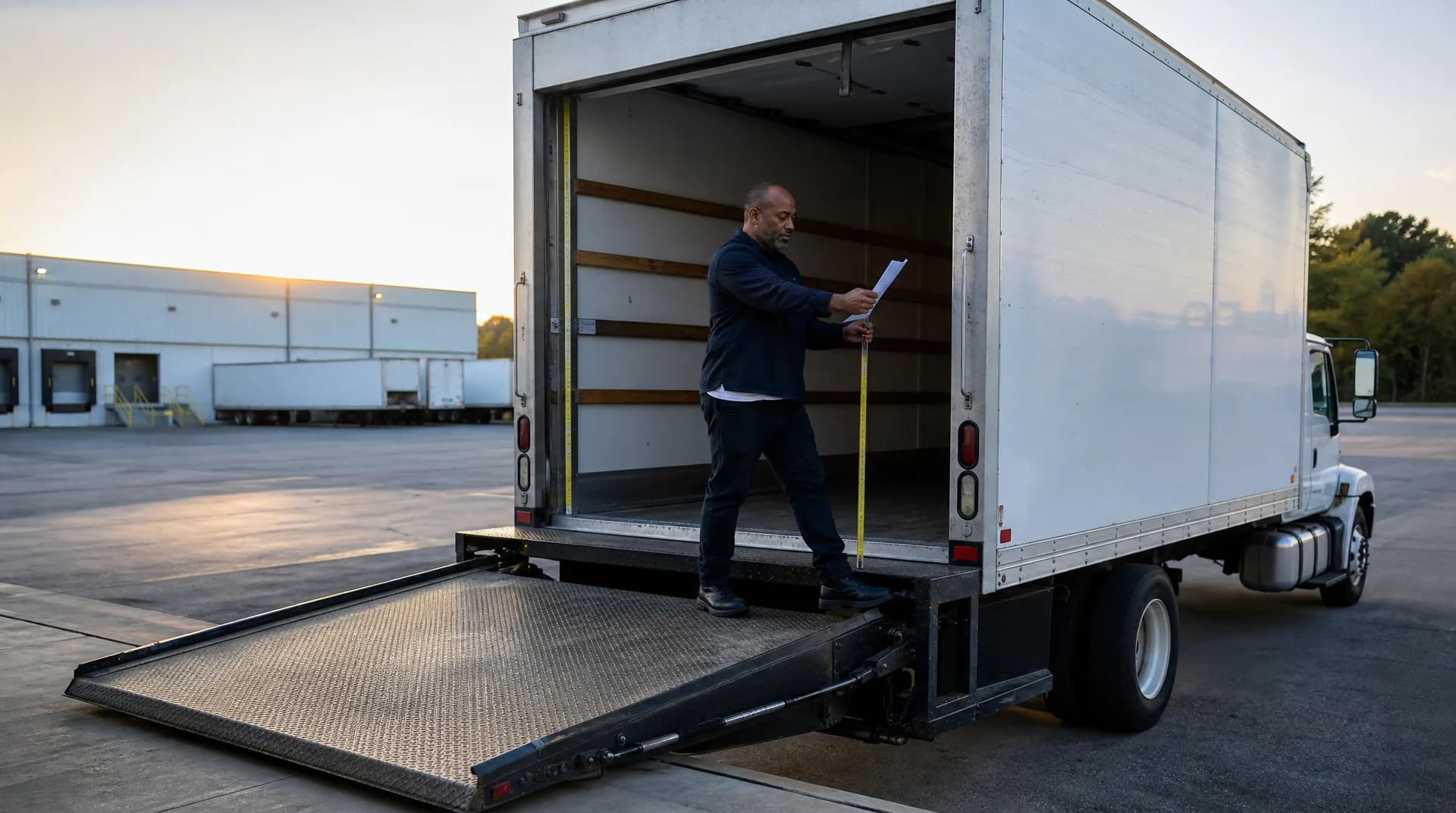
You need a DOT medical card when you drive a commercial motor vehicle in interstate commerce. For a truck hauling freight, the line is 10,001 pounds, measured as the truck’s weight rating or its actual weight, whichever is greater. Whether your cargo van, Sprinter or box truck is over that line is written on a label on your own truck. The model name does not decide it.
This guide walks through where the line sits, who can examine you, how long the card lasts and when you have to carry it. Everything here is the federal rule, from the FMCSA regulations in 49 CFR parts 390 and 391.
Where is the 10,001 pound line?
Federal rules call a vehicle a commercial motor vehicle (CMV) when it is used on a highway in interstate commerce to carry property and it has a gross vehicle weight rating, gross combination weight rating, gross vehicle weight or gross combination weight of 10,001 pounds or more, whichever is greater (49 CFR 390.5). Drivers of a CMV have to be medically certified (49 CFR 391.41).
Four numbers, and the highest one counts:
- Gross vehicle weight rating (GVWR). The maximum loaded weight the manufacturer specifies for the vehicle. It is printed on the manufacturer’s certification label on the driver’s door or door frame.
- Gross combination weight rating. The rating for the truck plus a trailer. Hooking a trailer to a van rated under 10,001 pounds can put the combination over the line.
- Gross vehicle weight and gross combination weight. What the truck, or truck and trailer, actually weighs on the road. A truck loaded past its rating to 10,001 pounds or more is over the line on actual weight.
- Placarded hazardous materials. A separate part of the same definition makes any vehicle carrying hazmat in a quantity that requires placards a CMV, whatever it weighs.
What that means by truck:
- Cargo vans and Sprinters can fall on either side. The rating belongs to the specific vehicle and its configuration, so read the label on your own van rather than going by what someone else’s van of the same model is rated.
- Box trucks are rated on the truck’s own weight plus the load it may carry. A box truck loaded with 8,000 pounds of freight is over 10,001 pounds once the truck itself is counted. A smaller box truck may not be, so read the label: it is the number an inspector will read.
We cover the rest of what changes at 10,001 pounds in cargo van owner-operator requirements.
Does it matter if you only drive in one state?
It can. Interstate commerce under the federal definition covers three kinds of trips (390.5):
- between a place in one state and a place outside it;
- between two places in the same state, passing through another state or country;
- between two places in the same state as part of a shipment that started or will end outside the state or the country.
The third one catches drivers who never cross a state line themselves. A leg that stays inside one state can still be interstate commerce if the freight came from, or is headed to, another state or country. If all of your work is truly intrastate, the federal definition does not apply, and your state’s own rules decide whether you need a medical certificate. Check with your state before assuming you are exempt.

Own your truck and your MC?
StarBriges works with cargo van, Sprinter, box truck and straight truck owner-operators who run under their own authority. Send us your MC and truck details. We’ll review them within one business day.
Apply to run with StarBriges →Who can do the DOT physical?
Not every doctor. The exam has to be performed by a medical examiner listed on FMCSA’s National Registry of Certified Medical Examiners (49 CFR 391.43). The rule allows two exceptions: a licensed ophthalmologist or optometrist may do the vision part of the exam, and a certified VA medical examiner may examine veterans.
Before you book, ask the clinic whether the examiner who will see you is on the National Registry. A few more things the same rule sets out:
- The certificate. If you drive without a CDL and pass, the examiner gives you the original medical examiner’s certificate, Form MCSA-5876.
- Pending results. If the examiner needs more information or more tests before deciding, you have 45 days to provide them, and the pending status is reported to FMCSA.
- Results go to FMCSA. The examiner sends the results to FMCSA electronically by midnight local time of the next calendar day after the exam.
- A failed exam cancels old cards. If an examiner finds you not physically qualified, all medical examiner’s certificates previously issued to you stop being valid. A card that still shows a future date does not cover you after that.
How long is a DOT medical card good for?
The longest gap the rules allow between exams is 24 months (49 CFR 391.45). Some drivers have to be re-examined every 12 months:
| Situation | Re-exam required |
|---|---|
| Most drivers | Within 24 months of the last certification |
| Insulin-treated diabetes, certified under 391.46 | Within 12 months |
| Certified under the alternative vision standard in 391.44 | Within 12 months |
| Driving only within an exempt intracity zone | Within 12 months |
| Ability to drive impaired by an injury or illness | Before driving again, no fixed interval |
Put the date on your card into your calendar with a few weeks to spare. When it lapses, you are not medically certified, and you cannot drive a CMV until you are recertified.
Do you have to carry the card?
It depends on whether you hold a CDL.
- Without a CDL: when on duty, you must have the original or a copy of your current medical examiner’s certificate on you (391.41). A CDL for a single truck carrying general freight without placarded hazmat starts at 26,001 pounds, by rating or actual weight, whichever is greater (49 CFR 383.5), so a driver below that line can need the medical card without needing a CDL.
- With a CDL or learner’s permit: on or after June 23, 2025, a driver with a current certificate no longer needs to carry it (391.41).
- With a medical variance: if you qualified through an FMCSA exemption letter or skill performance evaluation certificate, carry a copy of that document when on duty (391.41).
Where the CDL line sits for straight trucks, and what else changes there, is covered in box truck owner-operator jobs.
What if you put another driver in your truck?
Under your own MC, your company is the motor carrier. A motor carrier keeps a driver qualification file for each driver it employs, and the federal definition of employee includes an independent contractor operating a CMV (390.5). That file has to include the driver’s medical examiner’s certificate or a legible copy and, for a driver without a CDL, a note showing you verified the examiner was listed on the National Registry (49 CFR 391.51). Check both before the driver’s first load, not after.
The medical card is one of several credentials a carrier or shipper can ask about. The others, from hazmat endorsements to drug testing, are in endorsements and credentials.
Frequently asked questions
Do I need a DOT medical card if I don’t have a CDL?
Yes, if you drive a CMV in interstate commerce. The medical card and the CDL have separate thresholds: the medical card starts at 10,001 pounds (390.5), and a CDL for a single truck starts at 26,001 pounds (383.5). Between the two, you need the card without the CDL, and you carry the card on duty.
Does a cargo van driver need a medical card?
Only if the van is a CMV: used in interstate commerce and at 10,001 pounds or more by rating or actual weight, including any trailer, or carrying placarded hazmat. Read your van’s label, and check again if you add a trailer.
Can my regular doctor do a DOT physical?
Only if they are a certified medical examiner listed on the National Registry. Otherwise the exam does not count for a medical certificate (391.43).
What happens if I fail the DOT physical?
You are not medically certified, and all medical examiner’s certificates issued to you before that exam are no longer valid (391.43). You cannot drive a CMV until a registered examiner certifies you again.
Does StarBriges work with Sprinter and box truck drivers?
Yes. StarBriges works with cargo van, Sprinter, box truck and straight truck drivers, and currently partners with active carriers who have both their own truck and MC authority. If you are set up and certified, see how to run with StarBriges.