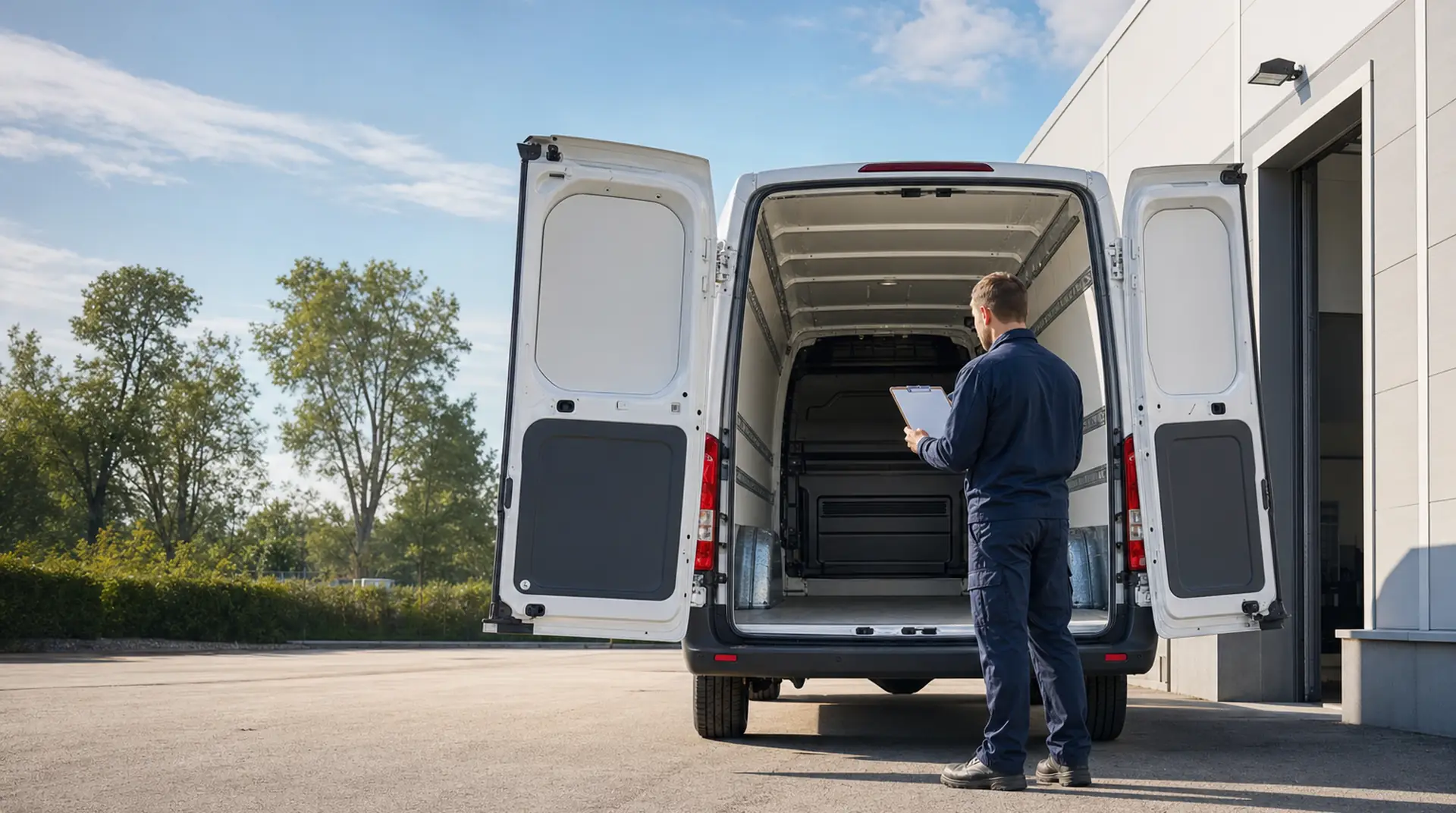
Running team means two drivers in one van, alternating so the wheels keep turning while one of you sleeps. It roughly doubles the miles a unit covers in a day, which is why the longest and best-paying expedite freight goes to teams first. It also doubles the people the load has to pay for, and that is where the decision actually lives.
What does running team actually mean in expedite?
It means the van is never parked for rest. One driver drives, the other sleeps in the back, and you swap at fuel stops. A solo driver on a 1,400-mile run stops for the night; a team delivers straight through. Dispatchers do not offer team freight to solo drivers, so this is less a preference than a separate category of work you either qualify for or do not.
Two things follow from that. First, the van has to be liveable for two people, not just driveable. Second, the pair has to actually get along on day four, which is the part nobody plans for and the part that ends most teams.
How much more freight does a team see?
The difference is not a percentage on the same board, it is access to loads a solo van is never shown. Long-haul expedite, time-critical runs with a delivery window shorter than the drive time plus a rest break, and cross-country moves that a solo driver would need two or three days to complete all get routed to teams. Solo drivers see the shorter regional half of the board.
What that is worth in dollars depends on the lane and the season, and any single figure you are quoted is a range with the ends left off. The honest way to size it is to look at what your own van earned per week solo and ask whether the same van running continuously can cover a second person and still leave both of you better off. Our breakdown of what cargo van owner-operators earn is the place to start that arithmetic.
What changes about hours of service?
Less than most drivers expect, and the reason is weight. Federal hours-of-service rules live in 49 CFR Part 395 and apply to commercial motor vehicles, which for a property carrier begins at 10,001 pounds gross vehicle weight rating (49 CFR 390.5). A large share of cargo vans and the lighter Sprinter configurations sit below that line and are outside Part 395 entirely.
That has three practical consequences:
- Check your own GVWR, not the model name. The same badge on the back covers configurations on both sides of 10,001 pounds. The number on the door jamb decides which rules you are under.
- Above the line, Part 395 applies to each driver individually - the 11-hour driving limit and the 14-hour window in 49 CFR 395.3 are per driver, which is exactly why a team keeps moving while a solo cannot.
- Being outside Part 395 is not the same as being safe to drive tired. Carriers and brokers set their own expectations, and a fatigue-related incident is judged on the facts, not on which rulebook applied.


Running team under your own MC?
StarBriges works with cargo van owner-operators nationwide, on time-sensitive freight, with weekly pay. Send your MC and van details. We’ll review them within one business day.
Apply to run with StarBriges →How do teams split the money?
There are three arrangements in common use, and the right one depends on who owns the van. A straight percentage split of the load pay is the simplest when both drivers are partners in the unit. A cents-per-mile arrangement pays the second driver for miles driven and leaves the risk with the owner. A fixed weekly wage is the cleanest for a hired co-driver and the most expensive in a slow week.
Whichever you pick, put it in writing before the first load, and be explicit about four things: who pays fuel and tolls, who covers a deadhead leg with no revenue, what happens to the split when only one of you is driving, and how the arrangement ends. Teams rarely break up over the percentage. They break up over the week nobody agreed how to handle.
What does a team need in the van that a solo does not?
A sleeping surface that a person can actually rest on while the van is moving over highway seams, and enough separation between the sleeping space and the cab that a conversation or a phone call does not end someone’s rest. Everything else is comfort; those two are what make the second driver useful instead of merely present.
- A secured bunk or platform, anchored - not a mattress laid on top of freight.
- A partition or curtain between the sleeping area and the cab, plus blackout for daytime rest.
- Climate that runs without the engine, or a plan for the nights it will not.
- Power for two people - two phones, two devices, and whatever the carrier requires you to keep charged.
- Storage that is not the cargo area, because two drivers’ belongings will otherwise cost you usable payload.
That last one is worth measuring rather than estimating. A sleeping platform and two people’s gear consume real cargo length and real payload, and the numbers on your spec sheet change the day you build the van out for team. Re-measure and re-send the spec sheet, or you will be quoted freight that no longer fits.
Who should not run team?
Anyone whose solo numbers do not work yet. Team does not fix a van that is losing money - it adds a second person to the same problem and speeds it up. If your rate per mile, your deadhead percentage, or your maintenance reserve is the thing that is wrong, fix that first as a solo, where the mistakes are cheaper.
Two other cases are worth naming honestly. If you have not settled how you get loads - broker relationships, load boards, a carrier you run under - a team amplifies the gaps between loads rather than filling them; our guide on how cargo van owner-operators find loads covers that ground. And if the co-driver you have in mind is someone you have never spent an uninterrupted week with, treat the first month as a trial with a written exit, not as a partnership.
Is team worth it for you?
Answer three questions on paper before you answer it in the van. What did this van gross solo in an average week, not a best week? What will the second driver cost under the arrangement you are proposing, in a slow week as well as a good one? And do you have access to the long-haul team freight that justifies the build - or are you hoping it appears once you are ready for it?
If the answers hold up, the build-out and the co-driver agreement are the easy part. For a wider look at how team work sits inside expedite, see our post on team drivers in expedited freight. When you are ready, the rest of the owner-operator guides cover the pieces around it, and running with us is where the team freight comes from.