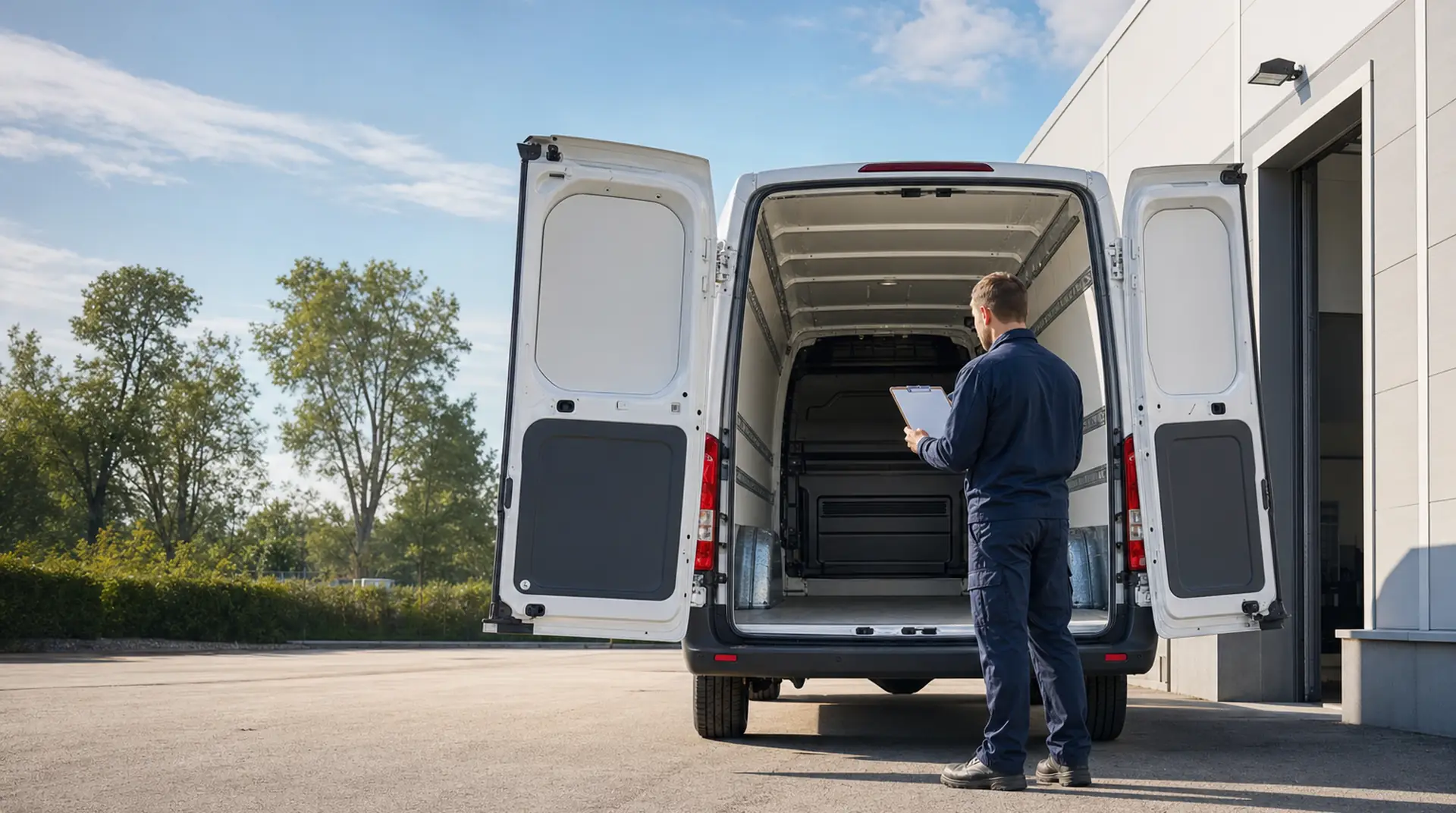
Dispatchers do not book a van, they book a spec. What decides whether you get offered a load is the usable cargo length, the payload left after your own weight, the door opening, and whether you carry the securement equipment the shipper expects to see. Two vans that look identical in a photo can be quoted completely different freight because of those four lines.
What specs does a dispatcher ask for first?
Have these ready as a single block of text you can paste, because you will be asked for them on every first contact:
- Usable cargo length, width, height - measured inside, floor to ceiling and wall to wall, not the manufacturer’s brochure figure.
- Width between the wheel wells - the number that decides whether a standard pallet fits flat or has to be turned.
- Rear and side door opening, height and width.
- Available payload - GVWR minus what your van actually weighs today with you, your fuel and your equipment in it.
- Securement and handling equipment - e-track, load bars, straps, blankets, dolly, and whether you have a liftgate or ramp.
A driver who answers all five in one message gets offered freight ahead of a driver who answers “it’s a Sprinter”. That is not a preference, it is a dispatcher avoiding a load that will not fit.
How much can a cargo van actually carry?
Less than the brochure, and the gap is where drivers get into trouble. The number that matters is available payload: the GVWR on the door sticker, minus the curb weight, minus everything you added.
What comes out of your payload before any freight does:
- You, and a team partner if you run team.
- A full tank of fuel - fuel is heavy and it is in the curb weight only if the spec says so.
- A liftgate, if you have one. It buys you freight and it costs you payload, every mile.
- Shelving, a bulkhead, e-track, load bars, blankets, a pallet jack or dolly, tools, a spare.
- Anything you sleep on or with, if you sleep in the van.
The only honest way to know your number is to weigh the van loaded the way you actually run it - full fuel, all equipment, you in the seat - at a certified scale, and subtract that from the GVWR. Do it once, write it down, and quote that figure. Everything else is a guess you will find out about at a shipper’s scale.

Spec sheet ready?
Send StarBriges your MC and van details. We’ll review them within one business day, and you can hit the road within 24 hours.
Apply to run with StarBriges →Will a standard pallet fit?
It depends on the width between your wheel wells, not the width of the cargo area. A standard US pallet is 48 by 40 inches. Many cargo vans have less than 48 inches between the wheel wells, which means:
- The pallet goes in turned, 40 inches across, eating 48 inches of your length instead of 40.
- Or it goes in on top of the wheel wells, which only works if the height above them clears the freight.
- Or the freight has to be floor-loaded off the pallet, which takes time and is not always allowed.
So “how many skids” is answered by measurement, not by the model name. Measure between the wheel wells, measure the height above them, and know how many pallets you fit turned and how many flat. That is one line in your spec block and it settles the question every time.
What equipment do shippers expect you to carry?
Securement is not optional, and turning up without it is the fastest way to lose a customer on the first load. The working minimum:
- E-track or equivalent anchor points, plus straps rated for the freight. Rope is not securement.
- Load bars to stop freight sliding forward under braking.
- Moving blankets and corner protection - most expedite freight is high-value and damage comes out of your claim, not the shipper’s.
- A dolly or hand truck. Many delivery points have no dock and no help.
- A pallet jack if you have a liftgate - the two go together or neither is much use.
The list costs a few hundred dollars once and changes which loads you are allowed to take permanently.
Do you need a liftgate?
Not to start, and not on every van. It is a trade, and both sides of it are real:
- What it buys: access to freight at non-dock locations, single heavy pieces you could not lift, and a set of customers who filter their board by liftgate. It is one of the few equipment upgrades that appears directly in the rate.
- What it costs: the purchase and fitting, a permanent bite out of payload, more weight to fuel every mile, and one more thing that can fail and take you out of service.
The sensible sequence: run without one, keep a note every time you are turned down for a load because you lack it, and buy when that note gets long enough to pay for the gate. A ramp is the cheap middle option and covers a surprising share of the same freight.
Which specs open freight most other vans cannot take?
- Interior height you can stand in. A high-roof van loads and unloads faster and takes tall single pieces.
- A long wheelbase with real usable length - the difference between fitting three turned pallets and fitting four is a different rate class.
- Temperature control for pharma and food, which is a documented, audited capability rather than a cooler in the back.
- Team capability, which is a spec as much as a staffing choice - it changes which lanes you can be offered at all.
- Credentials - hazmat, TWIC, TSA clearance - which are not on the van but are on the spec sheet all the same.
None of these is worth buying speculatively. Each is worth buying once you can point at the loads you were not offered.
Write your spec sheet once
Measure the inside of the van, weigh it the way you run it, list the equipment, and keep the whole thing in a note you can paste in ten seconds. It makes you faster to quote than most of the drivers you are competing with, and it stops you accepting a load that was never going to fit.
Next: what carriers require on the insurance side, the rest of the owner-operator guides, and what running with us looks like once the van is ready.