A regional automotive supplier in Dayton gets a 9:14 a.m. Monday call from a Honda assembly plant in Greensburg, Indiana - 314 miles away. A wrong-revision bracket got built into the previous shift’s run. The line is down until the right revision lands. The plant manager wants the part on the dock by 1:30 p.m. so the next shift can run on the corrected build.
Standard LTL on the lane runs two days. Overnight parcel is too small for the 187-pound bracket assembly. The supplier dispatch desk picks up the phone and books a same-day sprinter: $1,180, dedicated van, single driver, 4 hours and 12 minutes door-to-door. The bracket lands at 1:18 p.m. The plant runs the next shift on time.
That’s what same-day delivery is built for - loads that need to be picked up and delivered the same calendar day on a clock the regular network can’t honor.
Same-day delivery service is the dedicated, point-to-point movement of freight or parcels with pickup and delivery completed inside the same business day, typically on a 4-12 hour transit window. It runs on dedicated equipment - sprinter van, cargo van, straight truck, courier car, or next-flight-out air - not on shared linehaul.
What separates same-day from next-day or expedited
Same-day, next-day, and expedited freight all sound similar in marketing copy. The operational differences are sharp.
What changes on a same-day move:
- Calendar-day pickup-to-delivery: load picks up and delivers the same business day, no overnight terminal dwell
- Dedicated equipment: one driver, one vehicle, your load only - no consolidation, no terminal hand-offs
- Hour-specific delivery window: same-day quotes a delivery hour, not a delivery day; receiver gets a near-real-time ETA
- Booking-to-pickup speed: dispatch typically rolls a vehicle within 30-90 minutes of the booking call
- Lane distance: most same-day ground runs inside 600 miles; longer lanes use next-flight-out air or coast-to-coast team driver
- Pricing model: flat rate by lane and equipment type, not by weight class - pricing is closer to taxi-meter than to LTL tariff
- Cost-of-delay framing: receivers paying same-day rates have a cost-per-hour problem that makes the rate the cheapest option on the table
Same-day is not faster LTL. It is dedicated direct dispatch on a vehicle sized for your load, with no shared trailer in the path.
What is same-day delivery service?
Same-day delivery service is the dedicated, direct movement of cargo or parcels with pickup and delivery completed inside one business day. It uses sprinter vans, cargo vans, straight trucks, courier vehicles, or commercial flights with on-board couriers - chosen by load size, lane distance, and the deadline at the receiver.
The defining trait is not vehicle type. It is that the dispatch desk commits to a single-day calendar window with hour-specific delivery, on a dedicated vehicle.
How does same-day delivery work?
A typical same-day ground move runs through four stages: dispatch books a vehicle within 30-90 minutes of the booking call; the driver picks up at origin with a sealed BOL and load-specific instructions; linehaul runs direct, with no terminal stops, on the most direct routing the lane allows; delivery completes at the receiver dock, often with photo POD and signature confirmation.
Transit time on same-day ground typically runs 4-12 hours door-to-door inside 600 miles. Air same-day (next-flight-out or charter) extends the lane reach to coast-to-coast in 7-10 hours door-to-door. The variable that wrecks a same-day move is rarely the vehicle. It is the booking margin - how late in the day the dispatch call happens relative to drive time and hours-of-service.
What a same-day failure actually costs
Same-day rates run $400-$3,500+ for ground and $2,500-$12,000+ for air, depending on lane and equipment. The freight bill is rarely the deciding cost. The receiver’s clock is.
Realistic cost ranges:
- Production line down on missing parts: $9,000-$50,000+ per hour on automotive, $5,000-$25,000 on most other manufacturing - first hour of line-down clears most same-day rates 5-20x
- Hospital surgical implant or equipment missing OR: $30,000-$200,000+ in surgical suite cost, surgeon and anesthesia time, patient rebooking
- AOG aircraft on ground: $10,000-$150,000+ per hour for commercial aircraft; same-day delivery of the part is the cheapest option on the table
- Retail floor-set deadline: missed reset window means empty shelves on peak day, vendor scorecard penalty
- Trade show booth at show site: missed move-in window means direct-to-show-site delivery at premium rates plus drayage compounding
- Time-stamped pharma release: held lot, downstream distribution re-sequenced, batch revenue delayed
- Court filing or evidence with deadline: missed filing, case impact, professional liability exposure
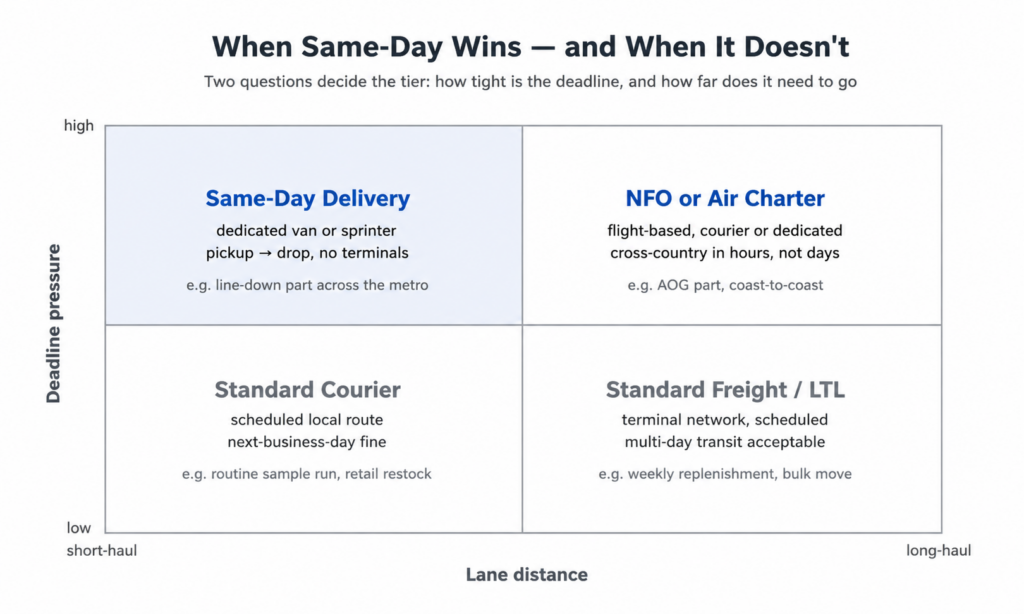
Same-day is rarely booked because the receiver wants speed. It is booked because the receiver has a specific clock - surgery start, line restart, aircraft return-to-service, court filing - that standard freight cannot hit.
When to use same-day delivery
The decision is rarely about speed in isolation. It is about which kind of clock is running on the receiver side.
Production-critical inbound parts
Manufacturers running JIT or lean inventory with line-down events, tooling failures, or wrong-revision parts use same-day to keep the line running. Automotive, aerospace, industrial, and food-and-beverage all generate same-day demand on production-critical inbound.
Medical, pharma, and surgical delivery
Hospital ORs scheduling procedures by the hour generate same-day demand for missing instruments, wrong-size implants, recalled components, and time-stamped pharma releases. Same-day medical and pharma is one of the highest-volume use cases in the entire same-day market.
AOG aerospace component delivery
Aircraft on ground events generate same-day demand for rotables, line-replaceable units, avionics, and tooling - usually moved on next-flight-out air with on-board courier or sprinter ground when the lane is under 600 miles.
Trade show and event freight on a tight clock
Trade show booths shipping direct to show site on a tight move-in clock use same-day when the advance warehouse cutoff has already passed.
High-value or chain-of-custody documents
Legal documents, evidence, signature-required deliveries, and high-value samples (semiconductors, biotech assays, gemstones) use same-day with chain-of-custody handling.
If your receiver has a clock that runs in hours, not days, you’re already in same-day territory. Get a same-day quote →
Is paying same-day rates worth it?
For routine freight with a 24-72 hour window, paying same-day rates is wasted budget. Standard expedited LTL or expedited dedicated handles those moves at 20-40% of same-day cost.
Same-day is the right call when:
- The receiver clock is running inside 12 hours, in hours not days
- Cost-of-delay clears the same-day rate by 10x or more (it usually does on production, medical, AOG)
- The load is dedicated-trailer or single-vehicle, not consolidated with other freight
- Chain-of-custody, signature, or hour-window delivery is required
- A standard expedited transit lands the freight after the receiver’s clock runs out
It is the wrong call on freight with multi-day deadline tolerance, on shipments that consolidate cleanly with other LTL freight without missing the receiver clock, or on lanes where overnight LTL hits the window at a fraction of the same-day rate.
Quick decision rule: do you actually need same-day?
The call usually clears up fast:
- If the receiver clock is inside 12 hours and the lane is under 600 miles → use same-day ground (sprinter, cargo van, straight truck)
- If the clock is inside 12 hours and the lane is over 600 miles → use next-flight-out air or team-driver ground
- If the clock is 12-24 hours and the load fits LTL → use expedited LTL, not same-day
- If the clock is 24-48 hours and the load fits dedicated → use expedited dedicated, not same-day
- If the load is over 26,000 pounds or oversize → use dedicated truckload or specialty equipment, not same-day van
- If the receiver doesn’t actually have an hour-specific deadline → use overnight or expedited LTL, not same-day
- If the lane is under 200 miles and the deadline is end-of-day → ground sprinter wins on cost and reliability over air
Operator rule: same-day is a clock-management service. The clock decides whether same-day fits - not the load size, not the lane distance, not the freight bill.
Same-day vs overnight vs expedited
The three tiers fit different deadline profiles.
| Option | Calendar window | Cost level | Vehicle |
|---|---|---|---|
| Same-day | Pickup and deliver same business day | High | Dedicated van, truck, or air with OBC |
| Overnight / next-day | Pickup today, deliver next business day | Medium | Expedited LTL or dedicated overnight |
| Expedited freight | 24-72 hour window | Medium | Dedicated truck or expedited LTL |
Same-day wins when the deadline runs in hours and the receiver clock can’t tolerate any overnight dwell. Overnight wins when next business day is acceptable and the load doesn’t justify dedicated same-day cost. Expedited wins on multi-day deadlines that are still tighter than standard LTL transit.
Why same-day moves go sideways
Same-day fails at the booking margin, not in transit. Almost every missed same-day traces back to one of three failure points: the booking happened too late in the day for the lane and HOS to support it, the pickup or delivery address had access constraints not flagged at booking, or the receiver’s hour-specific window shifted after dispatch and nobody told the driver.
Common failure points: dispatch calls at 2:30 p.m. for a 600-mile run with a 7 p.m. hard delivery, and HOS plus drive time don’t math; pickup is at a manufacturing site with a 30-minute dock-door queue and the driver loses an hour at origin; receiver is a hospital with restricted-access loading dock that requires badge or escort and the driver has neither; load is hazmat or restricted-cargo and the booking didn’t surface it.
The fix is dispatch discipline at the booking call: realistic transit math, accurate origin and receiver access details, hazmat and restriction flags surfaced before the truck rolls.
What your same-day carrier needs from you
The quote is only as accurate as the load and timing data on the call. Have these ready before dialing:
- Pickup and delivery addresses - origin facility, destination facility, dock or door contacts, named receiver
- Drop-dead time at the receiver - the hour the load has to be on the dock or in the OR
- Load details: weight, dimensions, packaging, hazmat or dangerous goods class, special handling
- Vehicle requirements: liftgate at origin or destination, dock-high, ground-load, refrigerated, hazmat-rated
- Receiver access specifics: hospital OR, airport FBO, dealer service bay, plant security check-in
- Origin readiness: is the load packaged, sealed, and ready for pickup, or does the driver wait?
- Documentation: BOL, commercial invoice, dangerous goods declaration, chain-of-custody requirements
- Cost-of-delay context at the receiver - what missing the window costs
A carrier that quotes same-day without asking about pickup readiness or receiver access details is guessing. A coordinator who asks about HOS math, dock-queue time at origin, and access constraints at delivery is doing the work to put the load on a vehicle that will actually clear the clock.
If you have a load that has to land same-day and the receiver clock is already running, the fastest path is to put the lane and the deadline against current capacity. Request a same-day quote here.
Same-day is a clock-management service, not just fast freight
Every same-day move comes down to the same situation: a load with a receiver clock running in hours, a lane that does or doesn’t fit ground, and a dispatch decision about which equipment hits the deadline with margin. The freight rate is the easy part. The hard part is reading the clock, the lane, the load, and putting the move on a vehicle that holds the window without burning the receiver’s deadline at the dock.
If you have a load that has to land same-day and you’re not sure whether ground sprinter, straight truck, or next-flight-out air is the right tool, get the details together: weight, lane, drop-dead time, receiver location specifics. Then request a same-day quote and a coordinator will price ground and air side by side against the clock you gave them.