A wholesaler ships a $480,000 pallet of mRNA vaccine from a San Diego depot to a Chicago distribution center. Reefer set to 2-8°C, registered driver, 30-hour run on a team-driver lane. Halfway through the trip, the data logger picks up a 38-minute excursion above 8°C while the truck idles at a fuel stop with the trailer doors cracked. The QA team at the Chicago receiver pulls the lot the moment the logger downloads. Five hundred thousand dollars of product sits in quarantine while a 14-day excursion investigation runs. The shipper recovers nothing.
That’s pharma cold-chain freight. Not a reefer rental, a chain of custody with temperature evidence the receiver’s QA can defend in front of an FDA inspector.
Pharma cold-chain freight is dedicated, validated, temperature-controlled transport for drugs and biologics that fail when temperature drifts outside spec. The defining trait isn’t the reefer - it’s the documentation chain that proves the load held its temperature from pickup to delivery, with calibrated loggers, GDP-trained handling, and a SOP that survives audit.
What pharma cold-chain freight actually means
Pharma cold-chain freight sits at the intersection of regulated transport and time-critical logistics. The defining trait is not the equipment - it’s the validated chain of evidence that has to clear before a receiver releases the load to commerce.
What separates it from generic reefer trucking:
- Validated equipment: temperature mapping records, calibrated reefer with redundant compressor logic, validated insulated containers
- NIST-traceable data loggers: each lot moves with at least one calibrated logger, often two, set to record at 1-5 minute intervals
- GDP-trained driver and dispatch: handler awareness of excursion protocol, no-idle-with-doors-open, temperature checks at pickup and delivery
- SOP-bound paperwork: bill of lading flagged temperature-sensitive, lot-level chain of custody, deviation log, signed receiving QA
- Regulatory framing: USP <1079>, 21 CFR Part 211 for finished pharmaceuticals, FDA GDP guidance, GDP EU Annex 15 if cross-border to Canada
Reefer trucking moves a temperature. Pharma cold-chain freight moves the proof that the temperature held.
What is cold chain pharmaceutical logistics?
Cold chain pharmaceutical logistics is the validated, temperature-controlled movement of drugs, biologics, and clinical samples that lose efficacy or fail regulatory release if temperature deviates outside their labeled storage range. It covers transport, intermediate storage, handling, and the documentation chain that proves the load held its required temperature from origin to destination.
The functional split: a refrigerated truck carrying produce is reefer trucking. A refrigerated truck carrying a 2-8°C biologic with calibrated data loggers, validated equipment records, GDP-trained driver, and lot-level chain of custody is cold chain pharmaceutical logistics.
What temperature ranges does pharma cold-chain cover?
Pharma cold-chain transport runs across four labeled temperature ranges, each with different equipment and risk profile:
- Controlled room temperature (15-25°C): most oral solid dose products, packaged tablets and capsules, OTC drugs. Insulated trailer with ambient control on long lanes in summer/winter extremes.
- Refrigerated (2-8°C): vaccines including most mRNA after thaw, insulin, monoclonal antibodies, blood products, ophthalmic biologics. The largest pharma cold-chain category by load count.
- Frozen (-15 to -25°C): clinical trial samples, some biologics, certain plasma products, allergen extracts. Mechanical freeze reefer or dry ice.
- Ultra-cold / deep frozen (-60 to -80°C): original mRNA vaccine storage, advanced cell and gene therapies, certain enzymes and rare biologics. Requires dry ice replenishment, ULT containers, or specialized cryogenic equipment.
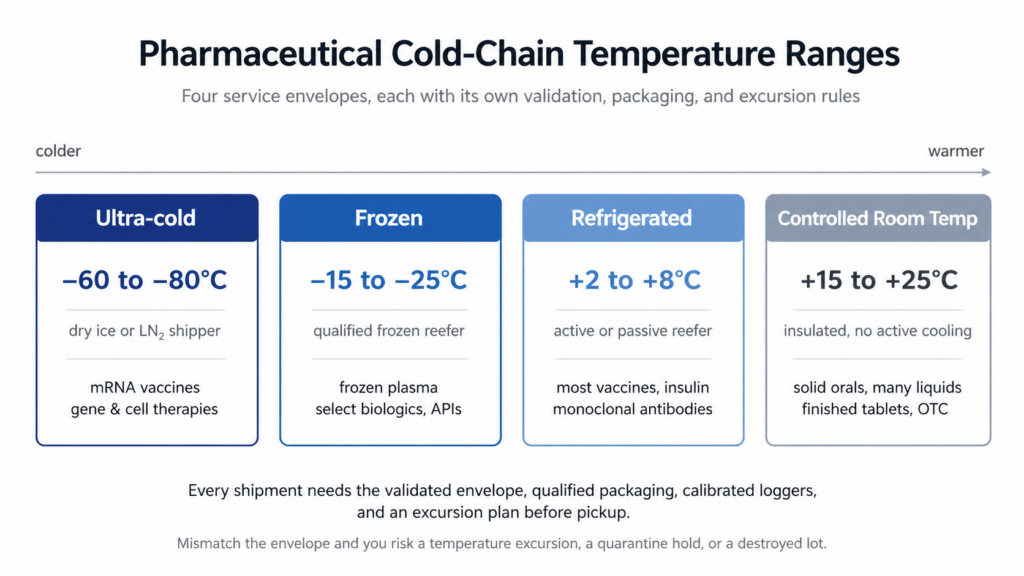
The choice of equipment is the booking decision. The wrong tier on either end - under-spec’d or over-spec’d - costs the shipper money or the load.
How do you ship temperature-sensitive pharmaceuticals?
You ship temperature-sensitive pharmaceuticals on validated equipment, with calibrated data loggers riding inside the load, under a written SOP that the receiver’s QA team can defend on release. None of those three pieces is optional. A reefer alone is not cold-chain freight.
Validated equipment means the reefer or insulated container has a temperature mapping record on file, redundant compressor or coolant logic, and a maintenance history the carrier can produce on request. Loggers ride inside the load itself, not on the trailer wall - usually one or two NIST-traceable units recording at 1-5 minute intervals, set up before pickup and pulled by the receiver at delivery.
The SOP and QA release is what closes the chain. The carrier’s SOP defines pickup checks, in-transit handling rules, excursion response, and delivery handoff. The receiver’s QA pulls the logger, reviews the temperature record against the product’s labeled storage range, and signs the release only when the load held spec. Without that signature the lot does not move into commerce, regardless of how the truck performed.
What a temperature excursion actually costs
The economics of pharma cold-chain freight rarely hinge on the freight bill. A single excursion event puts the load and the receiver’s release timeline at risk.
Realistic cost ranges:
- Quarantined biologic lot: $50,000-$5M+ in product value depending on the drug, plus 7-21 days of receiver QA investigation labor at $1,500-$3,000/day
- Vaccine excursion event: full lot rejection on most mRNA and adjuvanted products if cumulative time-out-of-range exceeds CMP-defined limits, with no recoverable product
- Clinical trial sample loss: re-collection cost on a trial subject ranges from $5,000 to over $50,000 per patient, plus calendar time the trial cannot recover
- Controlled substance temperature loss: DEA Form 222 reconciliation issues plus product write-off, often six figures for high-value oncology infusions
- Reputation cost with the receiver: a wholesale customer who quarantines two excursions in a quarter pulls the carrier off the approved-vendor list. Replacement carrier qualification runs 60-90 days
The freight premium for validated cold-chain is rarely the issue. The issue is whether the carrier you book can document that the load held temperature for the entire lane, with audit-ready evidence the receiver’s QA actually accepts.
When to use pharma cold-chain freight
The booking decision is rarely about freight cost. It’s about which regulatory and product-loss exposure you’re managing.
Vaccines and biologics
mRNA, viral vector, recombinant protein, and cell therapy products fail outside spec. The release decision is made by the receiver’s QA based on logger downloads. A carrier that cannot produce a calibrated logger record is a carrier that cannot move the load, period.
Clinical trial samples
Trial samples often move on tighter windows than commercial products because the sample itself is irreplaceable on a trial subject’s calendar. The carrier needs sample-level chain of custody, not just lot-level.
Controlled substances and high-value oncology
DEA-controlled cold-chain pharma adds Schedule II-V handling on top of temperature control. Two compliance regimes on one load. The carrier needs both DEA-registered handling and GDP-validated equipment.
Cross-border into Canada
Cross-border pharma cold-chain into Canada adds Health Canada GDP requirements (DMR section 11) and customs paperwork that flags the load as temperature-sensitive. Border dwell at temperature-uncontrolled inspection ramps is the single largest excursion risk on transborder lanes.
If your load fails outside spec and the receiver’s QA owns the release decision, you’re already in pharma cold-chain freight territory. The next call is which carrier can produce the documentation chain your QA will accept. Check pharma cold-chain capacity now →
Is pharma cold-chain freight worth the cost?
For non-temperature-sensitive pharma freight - bulk packaging materials, marketing samples, non-regulated medical devices in ambient - paying validated cold-chain rates is wasted budget. Standard truckload covers it.
Validated cold-chain is the right call when:
- The product label specifies a controlled temperature range
- The receiver’s QA pulls and tests the data logger before release
- A single excursion event costs more than the freight premium by 10x or more
- The load includes a biologic, vaccine, controlled substance, or clinical trial sample
It’s the wrong call on packaged ambient pharma with no labeled storage range, on bulk excipients, or on non-regulated supplements where receiver QA does not run logger checks.
Quick decision rule: do you actually need pharma cold-chain freight?
The call usually clears up fast:
- If the product label specifies 2-8°C, frozen, or ultra-cold storage → use validated pharma cold-chain freight
- If the receiver’s QA pulls a data logger before release → use validated cold-chain
- If the load is a clinical trial sample on a trial subject’s calendar → use cold-chain with sample-level chain of custody
- If the cargo is a DEA-controlled substance with temperature spec → use cold-chain plus DEA-registered carrier
- If the load is cross-border into Canada with biologic content → use cold-chain with Health Canada GDP awareness
- If the product is ambient-stable with no labeled storage range → standard truckload is the right tier
- If the load is a marketing sample with no QA release gate → standard freight is fine
Operator rule: the validated cold-chain premium is almost always smaller than the cost of one quarantined lot. When the math is close, price both side by side.
Reefer trucking vs pharma cold-chain freight vs specialty courier
The three options sit on different points of the regulated-handling curve.
| Option | Validation level | Cost level | Documentation depth |
|---|---|---|---|
| Reefer trucking | Equipment temperature only | Low-Medium | Driver log + reefer download |
| Pharma cold-chain freight | Validated equipment + GDP SOP | Medium-High | NIST loggers, SOP, deviation log, QA-ready paperwork |
| Specialty pharma courier | Hand-carry, sometimes air-charter, lot-level chain of custody | Highest | Sample-level chain of custody, often white-glove handoff |
Reefer trucking works for non-regulated cold cargo with no QA release gate. Pharma cold-chain freight covers most commercial drugs and biologics that move at lot level with validated equipment. Specialty courier wins on irreplaceable samples, ultra-high-value loads, or cross-border ultra-cold work where a single hand-off has to clear with no intermediate handling.
Why pharma cold-chain dispatch fails
Cold-chain freight fails when the documentation chain has a gap. Equipment failures matter, but the more common failure mode is paperwork the receiver’s QA cannot defend.
Common failure points: a logger battery dies mid-lane and the gap is unexplained; the reefer is set to a calibrated temperature but the load never reaches setpoint because pickup happened during a hot dock window; the driver opens the trailer at a fuel stop in summer and the excursion goes undocumented; the shipper hands the carrier the wrong SOP for the product class; the carrier’s GDP training certificate is two years expired and the receiver’s QA flags it on intake.
The fix is removing handoffs and pre-validating the chain. A direct cold-chain carrier with its own equipment, calibrated loggers, GDP-trained drivers, and SOP-bound dispatch produces a documentation chain that doesn’t fall apart at the receiver’s loading dock.
In practice, the shippers who lose lots are usually the ones who bought the temperature and forgot to buy the proof.
What your pharma cold-chain carrier needs from you
A cold-chain quote is only as good as the product-level detail at the call. Have these ready before dialing:
- Product class: drug name, NDC, lot number, schedule status if controlled
- Storage range: labeled storage temperature with acceptable excursion window per CMP
- Quantity and packaging: pallet count, weight, primary and secondary packaging insulation type
- Pickup conditions: warehouse cold-room staging, dock temperature at load time, named QA contact
- Receiver requirements: dock hours, QA release SOP, logger return protocol, named receiving contact
- Temperature monitoring spec: required logger type, sample interval, redundancy requirement
- Regulatory framing: GDP, USP <1079>, DEA registration if applicable, Health Canada GDP for transborder
A carrier that quotes without storage range and logger spec is guessing. A carrier that asks about the receiver’s QA release SOP is doing the work to make sure the documentation chain clears at delivery.
If you have a temperature-sensitive load that has to move and you need the proof to hold up at receiver QA, the fastest path is to put the lane and the product spec against current capacity. Request pharma cold-chain capacity →
When the load is temperature-sensitive, the booking decision is simple
Every pharma cold-chain move comes down to the same situation: a regulated product with a labeled temperature range, a receiver QA team that pulls the logger before release, and a freight chain that has to produce documentation a regulator could audit. The freight rate isn’t the conversation. The conversation is which carrier owns the chain end-to-end, runs validated equipment, hands the receiver a calibrated logger record, and lands the lot with paperwork the QA team can defend.
If you have a temperature-sensitive load on the dock, get the details together: product class, storage range, pickup conditions, receiver QA SOP, logger spec. Then request pharma cold-chain capacity or time-critical pharma and a real carrier will quote validated transport against the temperature spec you gave them.