A semiconductor packaging plant in Phoenix gets a 7:43 a.m. call from a customer in Albany, New York: a 240-pound vacuum pump assembly has to land at the customer dock by tomorrow morning for an 11 a.m. test gate. Standard ground LTL on the lane runs four days. Same-day ground is too long - 2,400 miles, no team-driver coverage available before noon.
The dispatch desk has three air options to compare: scheduled commercial cargo on the next outbound from PHX (cargo cutoff already burned for direct lifts), next-flight-out with on-board courier on a passenger flight (works under 150 pounds - the load is over), or air charter (small jet from Phoenix Sky Harbor, direct to Albany International, $14,200). The team books the next morning’s commercial cargo lift on a 6:15 a.m. PHX departure with FedEx Express Freight, ground at each end. Total: $3,840, dock-to-dock 18 hours, lands at customer dock at 9:42 a.m.
That’s the domestic air freight market in three sentences - scheduled commercial cargo, NFO with on-board courier, and charter, each chosen by load size, lane distance, and the receiver’s clock.
Domestic air freight services are the dedicated, time-critical movement of cargo on commercial passenger flights, dedicated cargo aircraft, or charter aircraft inside the United States - typically used when ground transit can’t hit the deadline or when the load value, sensitivity, or chain-of-custody requirements rule out shared linehaul.
What’s actually available in the domestic US air freight market
Domestic air freight breaks into three distinct service tiers, each with different operating models, equipment, and price points.
The three core service tiers:
- Scheduled commercial cargo - freight booked on dedicated cargo aircraft (FedEx, UPS, DHL Aviation) or in the belly of passenger flights, on published schedules with cutoff windows; rates are weight-based with class and accessorials
- Next-flight-out (NFO) with on-board courier - load placed on the next available commercial passenger flight, typically hand-carried by an OBC under 150 pounds; ground driver at each end
- Air charter - dedicated aircraft (small jet, turboprop, or larger if the load demands) from origin airport directly to destination airport, no scheduled cutoffs
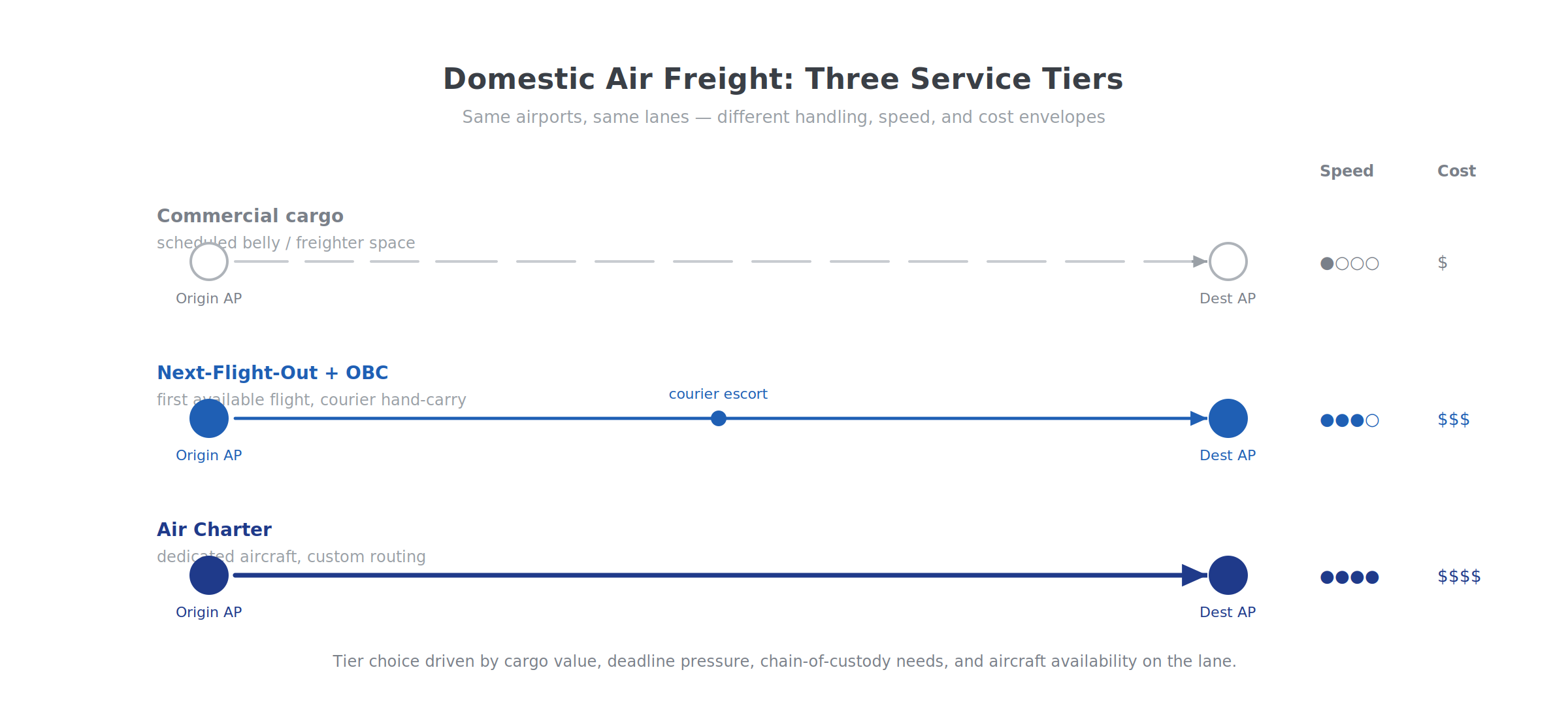
What ties all three together is the operating model: dispatch books the move based on load profile and receiver clock, ground transit handles origin and destination, and the airline cargo or charter operator handles the lift. Most domestic air freight moves are coordinated by an air freight provider that owns the dispatch and ground but partners with the airline or charter operator on the lift.
What is domestic air freight service?
Domestic air freight service is the time-critical movement of cargo by commercial passenger aircraft, dedicated cargo aircraft, or charter aircraft within the United States. It includes scheduled cargo on integrators (FedEx, UPS, DHL Aviation), next-flight-out with on-board courier on passenger flights, and dedicated charter aircraft for loads that don’t fit either model.
The defining trait is air lift - load travels by aircraft for at least one leg of the move. Ground at each end is part of the service.
How does domestic air freight work?
A typical domestic air freight move runs through five stages: dispatch books the lift based on load profile, lane, and deadline; ground driver picks up at origin and clears the load through airport cargo handling or escorts it to passenger check-in; the load flies on the chosen aircraft; ground driver meets the load at the destination airport (cargo terminal, FBO, or passenger baggage claim depending on service tier); last-mile delivery to the receiver dock or facility.
Transit times vary widely by service tier. Scheduled commercial cargo runs 12-48 hours dock-to-dock on most domestic lanes, depending on the cargo cutoff alignment with the deadline. NFO with OBC runs 4-10 hours dock-to-dock. Charter runs 3-8 hours dock-to-dock depending on aircraft positioning and lane distance.
What an air freight failure actually costs
Domestic air freight rates run $3 to $12 per pound for scheduled commercial cargo, $2,500-$15,000 flat for NFO with OBC, and $8,000-$45,000+ for charter inside the lower 48. The freight bill is rarely the deciding cost. The receiver’s clock is.
Realistic cost ranges:
- Production line down on missing parts: $9,000-$50,000+ per hour on automotive, $5,000-$25,000 on most other manufacturing - every air freight rate on the menu clears the first hour of line-down 5-20x
- Aircraft on ground (AOG): $10,000-$150,000+ per hour for commercial aircraft; same-day air delivery of the part is often the cheapest line item in the entire AOG event
- Hospital surgical implant or device missing OR: $30,000-$200,000+ in surgical suite cost, surgeon and anesthesia time, patient rebooking
- Time-stamped pharma lot release: held lot, downstream distribution re-sequenced, batch revenue delayed
- Trade show direct-to-show-site: missed move-in window means direct-to-show-site delivery penalties plus drayage compounding
- High-value sample missing qualification window: missed quality gate, program slip, supplier scorecard hit
- Court filing or evidence with deadline: missed filing, case impact, professional liability exposure
Air freight is rarely booked because the receiver wants speed in the abstract. It is booked because the receiver has a specific clock - surgery start, line restart, AOG aircraft, court filing, qualification window - that ground transit cannot hit on the lane.
When to use each air freight service tier
The decision is rarely about service tier in the abstract. It is about which kind of clock is running, what the load weighs, and how the lane prices out.
Use scheduled commercial cargo when
- Load is 150 to 2,000+ pounds and palletized or crated for cargo handling
- Deadline allows for the next scheduled cargo cutoff on the lane
- Cost-per-pound is the primary driver and the receiver clock has 18-48 hour tolerance
- Lane has direct cargo lifts (most major hub-to-hub corridors)
- Hazmat, declared value, or controlled-substance handling fits integrator capability
Use NFO with on-board courier when
- Load is under 150 pounds and the receiver clock runs same-day
- Chain-of-custody, signature, or hand-carry handling is required
- Standard cargo cutoffs on the lane don’t align with the deadline
- Hospital, AOG, semiconductor, biotech, legal, or regulatory delivery
- Commercial flights run hourly or near-hourly in the lane (NFO works best in dense passenger markets)
Use air charter when
- Load is over 150-2,000 pounds depending on lane and is time-critical same-day
- Cargo cutoffs and NFO booking windows have already burned
- Origin or destination airport is off the commercial passenger network
- Load is oversize, restricted, or requires controlled-environment handling
- Receiver clock is so tight that a dedicated tail beats waiting for any commercial schedule
- Lane volume is too thin for commercial cargo cost-effectiveness
Use ground expedited or same-day when
- Lane is under 600 miles and ground transit hits the deadline
- Load is too heavy or oversized for cost-effective air
- Cost-of-delay doesn’t justify the air premium
If your load needs to clear a same-day or next-day clock and the lane is over 600 miles, you’re in air freight territory. Get an air freight quote →
Is air freight worth it?
For routine freight with a 24-72 hour window on lanes under 1,500 miles, paying air freight rates is wasted budget. Standard expedited LTL or team-driver expedited dedicated handles those moves at a fraction of air cost.
Air freight is the right call when:
- The lane is over 1,500 miles and the deadline is inside 24-48 hours
- The lane is over 600 miles and the deadline is same-day
- Cost-of-delay clears the air premium by 5-20x or more
- Load size and value justify dedicated equipment or chain-of-custody handling
- AOG, OR-critical, or production-critical scenarios where ground transit math doesn’t pencil
It is the wrong call on freight with multi-day deadline tolerance, on lanes under 600 miles where ground hits the window, on loads that consolidate cleanly with other freight without missing the receiver clock, or when the load doesn’t actually have a same-day or next-day deadline.
Quick decision rule: which air service?
The call usually clears up fast:
- If the load is under 150 lbs and clock is same-day → use NFO with OBC
- If the load is 150-2,000 lbs and the deadline allows the next cargo cutoff → use scheduled commercial cargo
- If the deadline is inside 12 hours and over 600 miles → use air charter, commercial cargo cutoff has already burned
- If origin or destination airport is off the commercial network → use charter regardless of load size
- If the load is over 2,000 lbs same-day → use charter or split into multiple commercial cargo lifts
- If the lane is under 600 miles and clock is same-day → use ground sprinter or straight truck, not air
- If the load is hazmat, controlled substance, or restricted-cargo class → confirm carrier capability before booking any air tier
Operator rule: air freight wins when ground transit can’t clear the lane on the deadline. Below that bar, it’s overpaying for capacity you don’t need.
Domestic air freight tiers compared
The three tiers fit different load and clock profiles inside the air freight market.
| Option | Aircraft | Load size | Best fit |
|---|---|---|---|
| Scheduled commercial cargo | Cargo aircraft + passenger belly | 150-2,000+ lbs | 18-48 hour deadline, hub lanes |
| NFO with OBC | Commercial passenger flights | Under 150 lbs | Same-day, chain-of-custody |
| Air charter | Dedicated jet, turboprop, larger | Almost any | Same-day, off-network airports, oversize |
Commercial cargo wins on cost per pound when the cutoff aligns with the deadline. NFO wins on small same-day loads. Charter wins when neither commercial cargo nor NFO fits the lane or the clock.
Why air freight moves fail
Air freight failures cluster at the airport touchpoints, not in the air. Almost every miss traces to one of three patterns: the booking happened too late for the next cargo cutoff or NFO flight, the load had restrictions or documentation issues that surfaced at the cargo terminal, or the destination ground driver wasn’t pre-positioned at the right airport.
Common failure points: cargo cutoff was 2 hours before booking call and the next outbound is the morning after; load is hazmat without proper paperwork and the airline rejects it at the cargo terminal; OBC’s TSA Known Shipper documentation expired; destination flight diverted to an alternate airport and ground wasn’t repositioned; load documentation has wrong piece count or weight and customs/cargo screening kicks it back.
The fix is dispatch readiness and partner coverage at major airports. A coordinator running air freight every day knows the cutoff windows on each lane, has airline cargo desk relationships, and pre-positions ground at primary and alternate airports.
What your air freight provider needs from you
The quote is only as accurate as the load and deadline data on the call. Have these ready before booking:
- Pickup and delivery addresses - origin facility, destination facility, dock contacts, named receiver
- Drop-dead time at the receiver - the hour the load has to be on the dock
- Load details: weight, dimensions per piece, pallet count, packaging, hazmat/dangerous goods class
- Special handling: temperature controlled, fragile, high-value declared, chain-of-custody, controlled substance
- Origin readiness: when the load is staged, sealed, and ready for pickup
- Documentation: BOL, commercial invoice, dangerous goods declaration, SDS, regulatory paperwork
- Receiver access type: dock-high, ground-level, FBO, hospital OR, dealer service bay
- Cost-of-delay context at the receiver - what missing the deadline costs
A provider that quotes air freight without confirming load weight or hazmat status is selling a number. A coordinator who asks about origin airport, cargo cutoffs, and receiver airport access is doing the work to put the load on the right lift the first time.
If you have a load that needs air freight and the lane and deadline are clear, request an air freight quote here.
Domestic air freight is a clock-and-load-fit decision
Every domestic air freight move comes down to the same situation: a load with a deadline ground transit can’t hit, a lane that does or doesn’t have aligned commercial cargo cutoffs, and a dispatch decision about which lift - NFO, scheduled cargo, or charter - clears the receiver clock with margin. The freight rate is the easy part. The hard part is reading the lane, the cutoff window, the load size, and putting the move on a service tier that holds the deadline without burning budget on capacity you don’t need.
If you have a load that needs domestic air and you’re not sure whether commercial cargo, NFO, or charter is the right tool, get the details together: weight, lane, drop-dead time, receiver location specifics. Then request an air freight quote and a coordinator will price all three side by side against the clock you gave them.