A robotics line in Ohio goes down at 2 a.m. The missing part is a sensor module sitting at a supplier dock 600 miles away, and every hour the line stays idle costs more than the entire annual freight budget for that part.
That’s the moment you need expedited freight shipping. Not the next morning, not “as soon as possible,” but on the truck, on a clock.
Expedited isn’t really about speed. It’s about protecting a deadline that has a real cost behind it: a production line, a hospital floor, an aircraft on a tarmac. You book expedited shipping when the cost of being late is measurably bigger than the freight bill, and standard or LTL transit can’t be trusted to hit the time.
What expedited freight shipping actually means
Expedited freight is a direct, dedicated move from pickup to delivery. No consolidation, no terminal stops, one driver or a team running on a continuous transit window. In fact, delays in freight operations remain one of the biggest cost drivers in the industry, as highlighted by research from the American Transportation Research Institute.
Five things separate it from standard or LTL:
- Direct route from origin to destination, no terminal middle leg
- Continuous transit: team drivers swap on HOS to keep the truck moving; single drivers run on a dedicated, prioritized schedule
- 24/7 dispatch, with pickups and deliveries on your clock, not a terminal’s posted hours
- Single accountability: one carrier, one phone number, no broker handoffs
- Premium per mile: you pay to remove the parts of standard freight that introduce delay risk
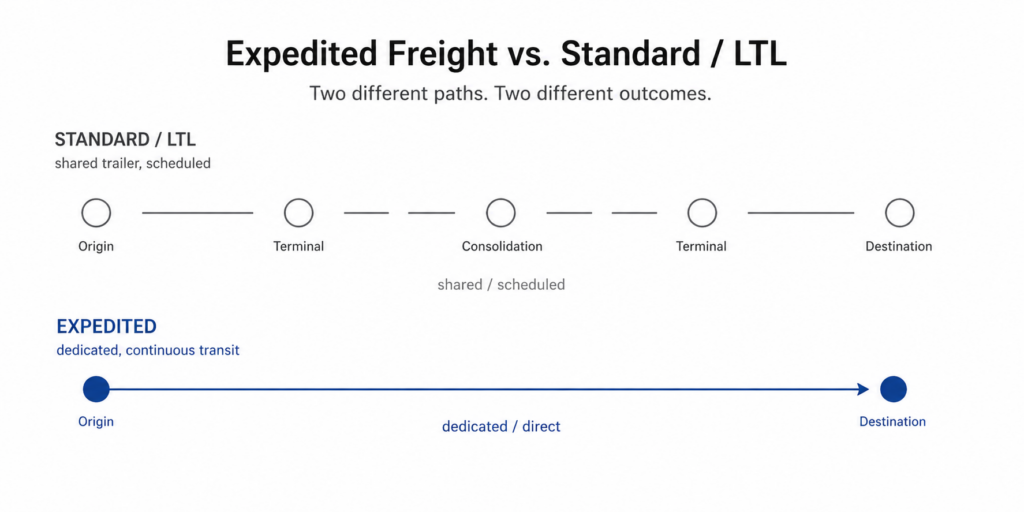
The trade-off is straightforward. You spend more per mile to strip out terminals, consolidation queues, and shared trailers, anything that takes the load out of your direct line of sight.
What is considered expedited freight?
Expedited freight is any shipment moved on a direct, dedicated truck with no terminal stops, no consolidation, and priority dispatch. The defining trait isn’t speed; it’s the absence of anything that could slow the truck down between origin and destination.
In practice, expedited covers cargo vans, Sprinter vans, box trucks, and straight trucks running point-to-point on a continuous transit window. Anything riding in a shared trailer or routed through a terminal is not expedited freight, regardless of how fast it’s marketed or quoted.
How fast is expedited freight shipping?
There’s no single answer because expedited transit is a function of distance, equipment, driver setup, and pickup readiness. A 500-mile single-driver run typically lands inside HOS limits the same day or the next morning. A 2,000-mile coast-to-coast move with a team usually runs 36–48 hours door-to-door.
The realistic frame: expedited removes the variability that turns a “two to three day” standard transit into a five-day surprise. A real expedited carrier quotes a window against your drop-dead time, not a generic ETA.
What being late actually costs
The reason expedited freight shipping exists is that for some loads, the cost of arriving late dwarfs the cost of moving fast. The math is rarely close.
A few realistic ranges:
- Production line downtime: $5,000–$20,000 per hour for mid-size manufacturing lines, higher for automotive OEMs and tier-one suppliers. A line-down event from a missing part stops idle workers, idle equipment, and every downstream commitment that depends on the line.
- AOG (Aircraft on Ground): $10,000+ per hour, often higher once you factor in displaced passengers, crew rebooking, and lost flight revenue. A grounded commercial aircraft is one of the most expensive idle assets in transportation, period.
- Retail stockout in a promo window: lost sales during peak traffic, plus a measurable hit to platform ranking and search visibility. The empty shelf or empty listing isn’t a one-day cost; it’s a weeks-long recovery.
- Pharma and clinical supply gaps: outcomes tied to patient care or trial integrity, with cold-chain excursions that can scrap an entire shipment regardless of arrival time.
The premium on the freight bill is rarely the issue when these clocks are running. The issue is whether the carrier you booked can actually hit the time.
When should you use expedited freight shipping?
The decision usually comes down to one question: what does it cost the receiver if this load is late? When the answer is bigger than the freight bill, expedited freight shipping pays for itself.
The patterns where the math holds up consistently:
Production line-down
Manufacturing and automotive lines stop the moment a critical part is missing. Idle workers, idle equipment, and missed downstream commitments all compound by the hour, and the cost of stopped production runs well past any premium freight rate.
The only meaningful question becomes how fast the part can be on the receiving dock.
Pharmaceutical and medical resupply
Clinical trial materials, hospital stockouts, temperature-controlled biologics, and surgical supplies have hard deadlines tied to patient outcomes. Cold chain integrity matters as much as transit time, and a temperature excursion can scrap the shipment regardless of when it arrives.
The right carrier here has refrigerated equipment, monitoring, and chain-of-custody documentation that meets FDA and state board requirements.
Aerospace AOG (Aircraft on Ground)
A grounded commercial aircraft burns parking fees, lost revenue, and crew rebooking costs by the hour. Expedited freight for AOG parts isn’t a cost discussion. It’s a get-the-part-on-the-tarmac discussion.
Retail stockout and promo windows
Promotional periods, seasonal launches, and e-commerce stockout windows have fixed timelines set by marketing calendars and platform algorithms. Missing the window leaves the shelf or listing empty during the highest-traffic days, and the recovery cost runs longer than the loss itself.
Trade show, event, and production tour cargo
Trade shows have move-in windows measured in hours, not days. Once the window closes, the booth gets set without the missing crate, and a missed deadline can’t be recovered with a discount on the next invoice.
If your load fits one of these patterns, you’re already in expedited territory. The next step is checking real-time capacity against your pickup window and drop-dead time. Request capacity and a quote →
Is expedited freight worth the cost?
For most shippers, expedited is wrong about 80% of the time and right about 20%. Knowing which side a load falls on saves money on both ends.
It’s the wrong booking when the deadline is comfortable. If your purchase order has standard lead time and the receiver carries buffer stock, paying for dedicated capacity is wasted budget. LTL freight or standard truckload is the right call.
It’s also a poor fit for cost-only buyers. Expedited exists to protect deadlines and remove variability. If the only criterion is cheapest per mile, the conversation isn’t about expedited at all.
Expedited is worth the cost when:
- The receiver has a fixed deadline and no buffer stock
- The downstream cost of being late is bigger than the per-mile premium
- Standard or LTL transit can’t be trusted to hit the time
- The load has special handling that consolidated freight can’t accommodate without risk
Quick decision rule: do you actually need expedited?
The call is usually simpler than it looks:
- If the receiver has a fixed deadline and no buffer stock → use expedited
- If the cost of being late is bigger than the freight premium → use expedited
- If your standard carrier has missed the same lane in the last 30 days → use expedited
- If the load needs handling consolidated freight can’t accommodate without risk → use expedited
- If the deadline has slack and the receiver carries buffer stock → do NOT use expedited
- If the only criterion is cheapest per mile → do NOT use expedited
- If origin and destination are in the same metro and the move can finish today → use same-day delivery, not expedited
Operator rule: when in doubt, price both. The premium on a single expedited load is almost always smaller than one hour of unplanned downtime.
LTL vs truckload vs expedited freight shipping
The three move types sit on a clear spectrum of speed, cost, and delay risk.
| Type | Transit model | Cost level | Delay risk |
|---|---|---|---|
| LTL | Shared trailer, terminal-to-terminal | Low | High |
| Truckload | Dedicated trailer, scheduled dispatch | Medium | Medium |
| Expedited | Direct, continuous transit | High | Low |
LTL works for non-urgent freight where the receiver has lead time. Standard truckload sits in the middle: dedicated capacity, but scheduled, non-priority dispatch. Expedited removes both terminal time and dispatch latency.
For short-haul loads where origin and destination are in the same market, same-day delivery is often the right call instead of expedited.
For coast-to-coast or international moves where ground transit is too long, air freight can be a leg of the route, usually combined with ground at both ends.
What your carrier needs from you upfront
Expedited quotes are only as realistic as the information the carrier has at quoting time. Loads that move smoothly are the ones where the shipper has the answers ready before the call:
- Pickup window: firm time, ready-now, or anytime today
- Delivery deadline: the drop-dead time, not “ASAP.” A real expedited carrier quotes against a clock
- Weight and dimensions: skid count, stackable or non-stackable, total weight, oversize dimensions
- Equipment: cargo van, Sprinter van, box truck, straight truck, refrigerated, lift gate
- Special handling: white glove, inside delivery, hazmat class, pharma cold chain, signature requirements
- Receiver hours and contact: a live phone number and the actual hours the dock will accept the load
A carrier that quotes without this information is guessing. A carrier that asks for it before quoting is doing the work that protects the deadline once the truck is rolling.
Why a direct carrier matters more than a broker
Expedited freight fails when there are too many handoffs. Every layer between shipper and truck adds delay risk, and on a load with hours of margin, latency in the chain is the same as missing the deadline.
A broker arrangement on an expedited move puts at least one extra step between the receiver and the driver. When something changes (pickup delays, weather, route closures, dock issues), every update has to travel from driver to carrier to broker to shipper. Brokers introduce latency in time-critical freight, even when the broker is competent and well-intentioned.
A direct carrier owns the chain end-to-end. The dispatch team, the driver, and the equipment are all under one operation. When the receiver moves a dock appointment up an hour, dispatch reroutes the truck without a phone tree.
That’s the operational reason StarBriges runs as a direct logistics and transportation provider with its own fleet: cargo vans, Sprinter vans, box trucks up to 8,000 pounds of cargo, and straight trucks up to 44,500 pounds. Coverage is the continental United States and Canada, with 24/7 dispatch and a single accountable team from pickup to delivery.
If you’re unsure whether your load qualifies as an expedited load, the fastest way to find out is to put the details against actual capacity. Check capacity against your timeline →
When the deadline is not negotiable
Every expedited move comes down to the same situation. There’s a deadline that can’t move, a receiver who needs the load to keep their operation running, and a cost of being late that justifies the premium.
When that’s the math in front of you, the booking decision isn’t about cheapest per mile. It’s about which carrier you trust to put the load on the dock at the time you said it would be there.
If you’ve got a load that fits the pattern (line-down part, pharma resupply, AOG order, retail stockout, tradeshow move-in), get the shipment details together first: pickup window, drop-dead delivery time, weight, dimensions, equipment, special handling. Then request a quote, and a real expedited carrier will come back with capacity, transit, and price against the clock you gave them.